# Using the API (https://docs.hireway.dev/docs/integrations/using-the-api)
The Hireway REST API lets your own scripts, extensions and automations read and change your documents and job applications. You authenticate with an API key that you create in Settings. This guide walks you through creating a key, making your first request and revoking the key when you're done.
## Before you start [#before-you-start]
- You need a Hireway account. The examples use `https://hireway.dev`.
- An API key acts as you. Anyone who has it can read and edit your documents, so treat it like a password.
## Create an API key [#create-an-api-key]
Select your name at the bottom of the sidebar, choose **Settings**, then open **AI & developer**. You can also press ⌘ K (Ctrl K on Windows and Linux) and type "API keys".
In the **API keys** section, select **New key**.
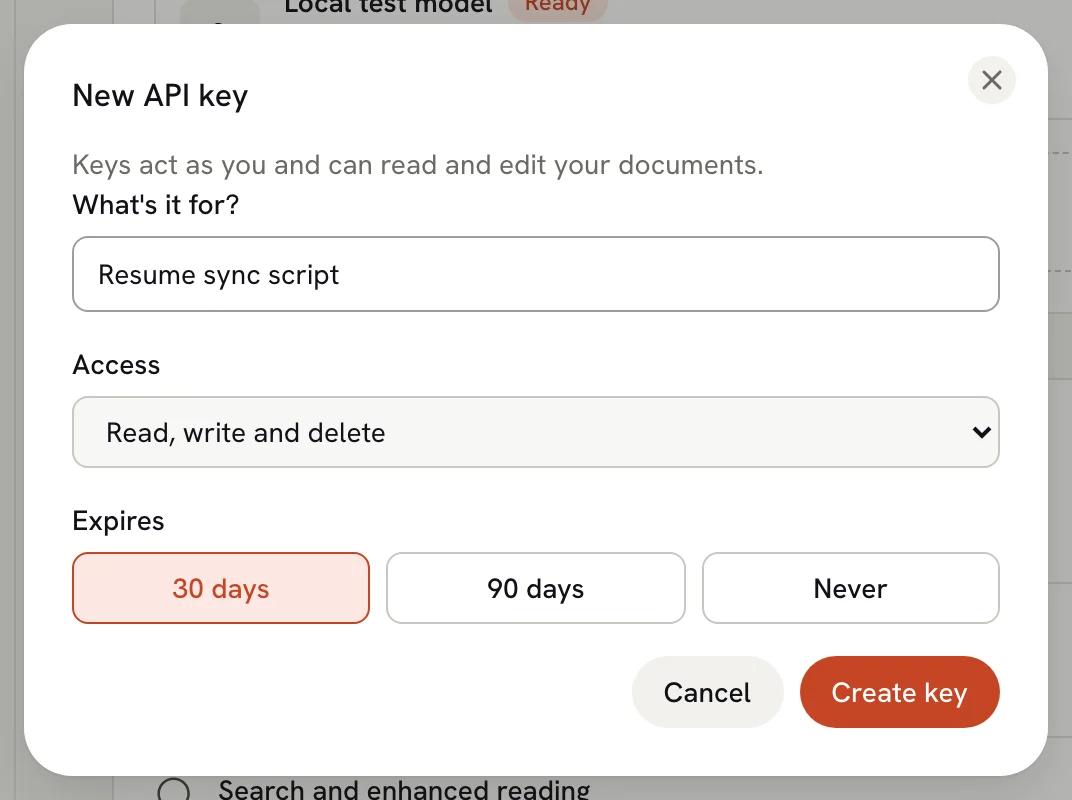
Under **What's it for?**, enter a name that reminds you where the key is used, such as "Resume sync script". Under **Expires**, choose **30 days**, **90 days** or **Never**, then select **Create key**.
 Select **Copy**, store the key somewhere safe (a password manager or your deployment's secret store), then select **Done**.
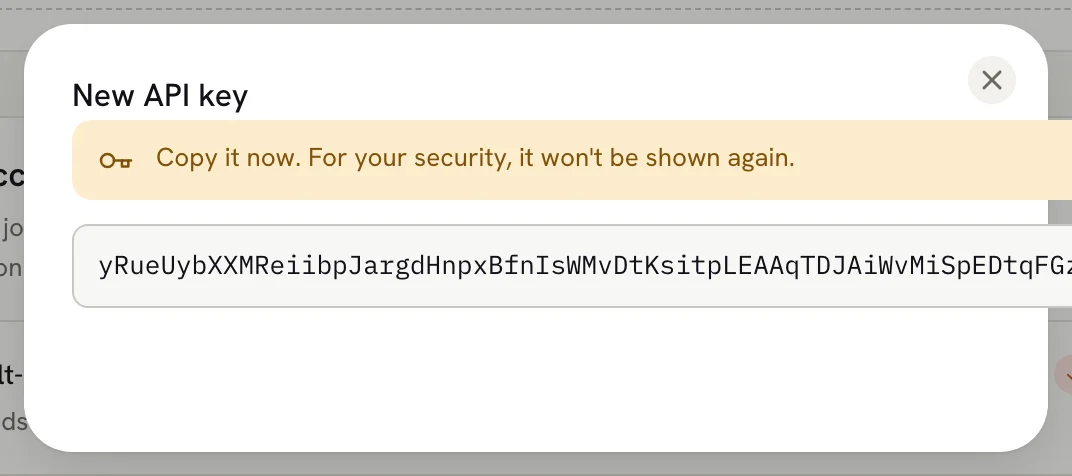 Hireway shows the key only once. If you lose it, revoke it and create a new one.
Your keys are listed in the **API keys** table with the date each was created, the date it was last used and when it expires. Expired keys disappear from the list and stop working.
Hireway shows the key only once. If you lose it, revoke it and create a new one.
Your keys are listed in the **API keys** table with the date each was created, the date it was last used and when it expires. Expired keys disappear from the list and stop working.
 ## Make your first request [#make-your-first-request]
The REST API lives under `/api/openapi` on `https://hireway.dev`. Send your key in the `x-api-key` header.
```bash
curl "https://hireway.dev/api/openapi/resumes" \
-H "x-api-key: YOUR_API_KEY"
```
The response is a JSON array of your resumes, without their full content:
```json
[
{
"id": "01a0efa5-6529-745e-950a-521ef5b8afc7",
"name": "Game Developer Resume",
"slug": "game-developer-resume",
"tags": ["games"],
"isPublic": false,
"showDownloadButtons": true,
"isLocked": false,
"createdAt": "2026-09-30T00:09:49.101Z",
"updatedAt": "2026-09-30T00:09:49.101Z"
}
]
```
Fetch one resume with its full data, using an ID from the list:
```bash
curl "https://hireway.dev/api/openapi/resumes/01a0efa5-6529-745e-950a-521ef5b8afc7" \
-H "x-api-key: YOUR_API_KEY"
```
For request bodies, send JSON with `Content-Type: application/json`. For example, create a resume filled with sample content:
```bash
curl -X POST "https://hireway.dev/api/openapi/resumes" \
-H "x-api-key: YOUR_API_KEY" \
-H "Content-Type: application/json" \
-d '{ "name": "Product Designer Resume", "tags": ["design"], "withSampleData": true }'
```
The response is the new resume's ID as a JSON string.
To change a few fields in a resume without sending the whole document, use [JSON
Patch](/docs/integrations/using-the-patch-api).
## Find the endpoint you need [#find-the-endpoint-you-need]
Every endpoint, with its parameters, request body and responses, is described in the machine-readable OpenAPI document at `https://hireway.dev/api/openapi/spec.json`. Use it to generate a client.
| Area | Paths | What you can do |
| ------------- | --------------------------------------- | ------------------------------------------------------------------------------------------------------------------------------------------------------ |
| Resumes | `/resumes`, `/resumes/{id}` | List, read, create, import, update, patch, lock, duplicate, move to Trash, set a sharing password, download a PDF, read version history and statistics |
| Cover letters | `/cover-letters` | List, read, create, update, duplicate, export and import letters, restore versions, refresh their design from a resume |
| Documents | `/documents` | Work across resumes and letters: rename, tag, lock, link to an application, move to Trash, restore, delete now |
| Applications | `/applications` | Track job applications: stages, notes, interviews, attached PDFs, bulk changes, import, statistics |
| AI | `/ai-providers`, `/ai`, `/agent` | Manage your AI providers, run AI tools such as resume import from PDF, work with assistant conversations |
| Account | `/auth/account/export`, `/auth/account` | Export your account data, delete your account |
Additional app workflows have REST endpoints:
| Workflow | Endpoint |
| --------------------------------------------------------------------------------------- | -------------------------------------------------------------------------------- |
| PDF, JSON Resume, Hireway JSON (current and legacy v4), LinkedIn imports | `POST /resumes/file-imports` |
| PDF, Word, Markdown and JSON exports | `GET /resumes/{id}/exports/{format}`, `GET /cover-letters/{id}/exports/{format}` |
| Editor content checks and job-term matching | `GET /resumes/{id}/checks`, `POST /resumes/{id}/job-matches` |
| Public PDF readability checker | `POST /pdf-checks` |
| File uploads and deletion | `POST /files`, `DELETE /files` |
| Web search integration settings and connection tests | `/integrations/web-access` |
| Sign-in, sessions, profile, passwords, two-factor authentication, passkeys and API keys | `/api/auth/*` (outside `/api/openapi`) |
Authentication workflows use Better Auth's native HTTP API and its own error contract. Hireway publishes their specification at `/api/auth/open-api/generate-schema`; use that specification for the enabled authentication methods. Browser interactions such as zoom, print dialogs and local undo do not require separate server endpoints: use document changes, versions and exports for the corresponding data workflows.
`GET /api/health` (outside `/api/openapi`) reports whether the service and its database and storage are healthy. It needs no key.
## Imports and exports [#imports-and-exports]
File imports accept a multipart form. The format is one of `PDF`, `HIREWAY`, `HIREWAY_V4`, `JSON_RESUME` or `LINKEDIN`; the maximum file size is 10 MiB. PDF imports read the text layer without AI. AI-assisted PDF and Word parsing remain available under `/ai/pdf-parses` and `/ai/docx-parses`; save the resulting data through `/resumes/imports`.
```bash
curl "https://hireway.dev/api/openapi/resumes/file-imports" \
-H "x-api-key: YOUR_API_KEY" \
-F "format=JSON_RESUME" -F "file=@resume.json"
curl "https://hireway.dev/api/openapi/resumes/RESUME_ID/exports/docx" \
-H "x-api-key: YOUR_API_KEY" -o resume.docx
```
Exports accept `pdf`, `docx`, `md` or `json` and return a downloadable file. They enforce document ownership. The public checker accepts a multipart `file` (PDF, maximum 25 MB) and optional `jobDescription` text. It stores nothing, examines at most 30 pages and reports truncation or skipped checks. Parsing has a 45-second deadline. Hosting-provider request limits still apply.
## Pagination and partial updates [#pagination-and-partial-updates]
Collection endpoints support `limit` (1–100) and `offset` (zero-based). For existing array responses, omitting both preserves the complete array for compatibility. Supplying only `offset` selects a page size of 20. The `X-Total-Count` header reports the total before slicing; paginated responses also include `X-Limit` and `X-Offset`. The cover-letter list retains its existing `{ items, total }` response and default pagination.
```bash
curl "https://hireway.dev/api/openapi/resumes?limit=20&offset=20" \
-H "x-api-key: YOUR_API_KEY" -i
```
Use `PATCH` for partial application, interview, timeline-entry and cover-letter updates. Resume content uses JSON Patch at `/resumes/{id}`; metadata uses `PATCH /resumes/{id}/metadata`. Resource-oriented paths such as `/resumes/{id}/copies` and `/documents/{type}/{id}/trash` are preferred for new integrations. Existing verb-based routes, partial `PUT` routes, response shapes and enum values remain supported.
## Retries [#retries]
State-changing operations do not implement `Idempotency-Key`. Treat mutations as unsafe to retry automatically, including requests that timed out: the change might already have happened. Read the current resource before deciding whether to repeat a write. Repeating create, copy, import or AI operations can create duplicates or incur provider charges.
## Authentication methods [#authentication-methods]
The API accepts three kinds of credentials:
1. `x-api-key: `: an API key from Settings. Use this for scripts and servers.
2. `Authorization: Bearer `: an OAuth access token, which MCP clients get when you connect them with OAuth. See [Using the MCP server](/docs/integrations/using-the-mcp-server).
3. The session cookie of a signed-in browser.
Send one credential. When several are present, the server tries API key, bearer token, then session cookie, using the first valid credential. Cookie-authenticated requests with a foreign `Origin` or cross-site fetch metadata are rejected; explicit API keys and bearer tokens do not rely on browser cookies.
Account deletion (`DELETE /auth/account`) requires a browser session; API keys and OAuth tokens receive `403 FORBIDDEN`. Delete your account in **Settings → Account**.
A private request without valid credentials gets `401` with the code `UNAUTHORIZED`. Public operations are marked with `security: []` in the OpenAPI specification. Public resumes still enforce visibility, trash status and sharing passwords, and redact private data.
REST data responses use `Cache-Control: no-store`. Uploaded profile images are public; other uploaded files require the owner's credentials, including conditional download requests. Assistant attachments are not exposed through the uploads URL. Unknown and unauthorized file URLs return `404`.
## Limits [#limits]
| Limit | Value |
| ----------------------------------------------------------------------------------------------- | -------------- |
| Requests per API key | 1,000 per hour |
| Changes to one resume, document or application (create, update, patch, lock, duplicate, delete) | 300 per minute |
| PDF downloads of one resume (`GET /resumes/{id}/pdf`) | 5 per minute |
| Public PDF checks per client address | 5 per minute |
| REST request body size (before endpoint-specific limits) | 40 MiB |
| AI requests | 20 per minute |
Procedure limits apply in production. When you hit a limit, the API responds with `429`.
## Errors [#errors]
Errors come back as JSON with a machine-readable `code`, the HTTP `status` and a `message`. Validation errors also include the failing fields in `data.issues`.
```json
{ "defined": false, "code": "NOT_FOUND", "status": 404, "message": "Not Found" }
```
Branch on `code` rather than on the message text. Invalid input uses `400`, missing authentication `401`, forbidden actions `403`, missing or inaccessible resources `404`, conflicts `409`, oversized requests `413`, rate limits `429`, and unexpected failures `500`. Unexpected failures do not expose internal exception details.
## Revoke a key [#revoke-a-key]
Open **Settings**, then **AI & developer**. In the **API keys** table, find the key you want to stop.
Select **Revoke**. The key stops working at once, and a message confirms which key you revoked.
## Make your first request [#make-your-first-request]
The REST API lives under `/api/openapi` on `https://hireway.dev`. Send your key in the `x-api-key` header.
```bash
curl "https://hireway.dev/api/openapi/resumes" \
-H "x-api-key: YOUR_API_KEY"
```
The response is a JSON array of your resumes, without their full content:
```json
[
{
"id": "01a0efa5-6529-745e-950a-521ef5b8afc7",
"name": "Game Developer Resume",
"slug": "game-developer-resume",
"tags": ["games"],
"isPublic": false,
"showDownloadButtons": true,
"isLocked": false,
"createdAt": "2026-09-30T00:09:49.101Z",
"updatedAt": "2026-09-30T00:09:49.101Z"
}
]
```
Fetch one resume with its full data, using an ID from the list:
```bash
curl "https://hireway.dev/api/openapi/resumes/01a0efa5-6529-745e-950a-521ef5b8afc7" \
-H "x-api-key: YOUR_API_KEY"
```
For request bodies, send JSON with `Content-Type: application/json`. For example, create a resume filled with sample content:
```bash
curl -X POST "https://hireway.dev/api/openapi/resumes" \
-H "x-api-key: YOUR_API_KEY" \
-H "Content-Type: application/json" \
-d '{ "name": "Product Designer Resume", "tags": ["design"], "withSampleData": true }'
```
The response is the new resume's ID as a JSON string.
To change a few fields in a resume without sending the whole document, use [JSON
Patch](/docs/integrations/using-the-patch-api).
## Find the endpoint you need [#find-the-endpoint-you-need]
Every endpoint, with its parameters, request body and responses, is described in the machine-readable OpenAPI document at `https://hireway.dev/api/openapi/spec.json`. Use it to generate a client.
| Area | Paths | What you can do |
| ------------- | --------------------------------------- | ------------------------------------------------------------------------------------------------------------------------------------------------------ |
| Resumes | `/resumes`, `/resumes/{id}` | List, read, create, import, update, patch, lock, duplicate, move to Trash, set a sharing password, download a PDF, read version history and statistics |
| Cover letters | `/cover-letters` | List, read, create, update, duplicate, export and import letters, restore versions, refresh their design from a resume |
| Documents | `/documents` | Work across resumes and letters: rename, tag, lock, link to an application, move to Trash, restore, delete now |
| Applications | `/applications` | Track job applications: stages, notes, interviews, attached PDFs, bulk changes, import, statistics |
| AI | `/ai-providers`, `/ai`, `/agent` | Manage your AI providers, run AI tools such as resume import from PDF, work with assistant conversations |
| Account | `/auth/account/export`, `/auth/account` | Export your account data, delete your account |
Additional app workflows have REST endpoints:
| Workflow | Endpoint |
| --------------------------------------------------------------------------------------- | -------------------------------------------------------------------------------- |
| PDF, JSON Resume, Hireway JSON (current and legacy v4), LinkedIn imports | `POST /resumes/file-imports` |
| PDF, Word, Markdown and JSON exports | `GET /resumes/{id}/exports/{format}`, `GET /cover-letters/{id}/exports/{format}` |
| Editor content checks and job-term matching | `GET /resumes/{id}/checks`, `POST /resumes/{id}/job-matches` |
| Public PDF readability checker | `POST /pdf-checks` |
| File uploads and deletion | `POST /files`, `DELETE /files` |
| Web search integration settings and connection tests | `/integrations/web-access` |
| Sign-in, sessions, profile, passwords, two-factor authentication, passkeys and API keys | `/api/auth/*` (outside `/api/openapi`) |
Authentication workflows use Better Auth's native HTTP API and its own error contract. Hireway publishes their specification at `/api/auth/open-api/generate-schema`; use that specification for the enabled authentication methods. Browser interactions such as zoom, print dialogs and local undo do not require separate server endpoints: use document changes, versions and exports for the corresponding data workflows.
`GET /api/health` (outside `/api/openapi`) reports whether the service and its database and storage are healthy. It needs no key.
## Imports and exports [#imports-and-exports]
File imports accept a multipart form. The format is one of `PDF`, `HIREWAY`, `HIREWAY_V4`, `JSON_RESUME` or `LINKEDIN`; the maximum file size is 10 MiB. PDF imports read the text layer without AI. AI-assisted PDF and Word parsing remain available under `/ai/pdf-parses` and `/ai/docx-parses`; save the resulting data through `/resumes/imports`.
```bash
curl "https://hireway.dev/api/openapi/resumes/file-imports" \
-H "x-api-key: YOUR_API_KEY" \
-F "format=JSON_RESUME" -F "file=@resume.json"
curl "https://hireway.dev/api/openapi/resumes/RESUME_ID/exports/docx" \
-H "x-api-key: YOUR_API_KEY" -o resume.docx
```
Exports accept `pdf`, `docx`, `md` or `json` and return a downloadable file. They enforce document ownership. The public checker accepts a multipart `file` (PDF, maximum 25 MB) and optional `jobDescription` text. It stores nothing, examines at most 30 pages and reports truncation or skipped checks. Parsing has a 45-second deadline. Hosting-provider request limits still apply.
## Pagination and partial updates [#pagination-and-partial-updates]
Collection endpoints support `limit` (1–100) and `offset` (zero-based). For existing array responses, omitting both preserves the complete array for compatibility. Supplying only `offset` selects a page size of 20. The `X-Total-Count` header reports the total before slicing; paginated responses also include `X-Limit` and `X-Offset`. The cover-letter list retains its existing `{ items, total }` response and default pagination.
```bash
curl "https://hireway.dev/api/openapi/resumes?limit=20&offset=20" \
-H "x-api-key: YOUR_API_KEY" -i
```
Use `PATCH` for partial application, interview, timeline-entry and cover-letter updates. Resume content uses JSON Patch at `/resumes/{id}`; metadata uses `PATCH /resumes/{id}/metadata`. Resource-oriented paths such as `/resumes/{id}/copies` and `/documents/{type}/{id}/trash` are preferred for new integrations. Existing verb-based routes, partial `PUT` routes, response shapes and enum values remain supported.
## Retries [#retries]
State-changing operations do not implement `Idempotency-Key`. Treat mutations as unsafe to retry automatically, including requests that timed out: the change might already have happened. Read the current resource before deciding whether to repeat a write. Repeating create, copy, import or AI operations can create duplicates or incur provider charges.
## Authentication methods [#authentication-methods]
The API accepts three kinds of credentials:
1. `x-api-key: `: an API key from Settings. Use this for scripts and servers.
2. `Authorization: Bearer `: an OAuth access token, which MCP clients get when you connect them with OAuth. See [Using the MCP server](/docs/integrations/using-the-mcp-server).
3. The session cookie of a signed-in browser.
Send one credential. When several are present, the server tries API key, bearer token, then session cookie, using the first valid credential. Cookie-authenticated requests with a foreign `Origin` or cross-site fetch metadata are rejected; explicit API keys and bearer tokens do not rely on browser cookies.
Account deletion (`DELETE /auth/account`) requires a browser session; API keys and OAuth tokens receive `403 FORBIDDEN`. Delete your account in **Settings → Account**.
A private request without valid credentials gets `401` with the code `UNAUTHORIZED`. Public operations are marked with `security: []` in the OpenAPI specification. Public resumes still enforce visibility, trash status and sharing passwords, and redact private data.
REST data responses use `Cache-Control: no-store`. Uploaded profile images are public; other uploaded files require the owner's credentials, including conditional download requests. Assistant attachments are not exposed through the uploads URL. Unknown and unauthorized file URLs return `404`.
## Limits [#limits]
| Limit | Value |
| ----------------------------------------------------------------------------------------------- | -------------- |
| Requests per API key | 1,000 per hour |
| Changes to one resume, document or application (create, update, patch, lock, duplicate, delete) | 300 per minute |
| PDF downloads of one resume (`GET /resumes/{id}/pdf`) | 5 per minute |
| Public PDF checks per client address | 5 per minute |
| REST request body size (before endpoint-specific limits) | 40 MiB |
| AI requests | 20 per minute |
Procedure limits apply in production. When you hit a limit, the API responds with `429`.
## Errors [#errors]
Errors come back as JSON with a machine-readable `code`, the HTTP `status` and a `message`. Validation errors also include the failing fields in `data.issues`.
```json
{ "defined": false, "code": "NOT_FOUND", "status": 404, "message": "Not Found" }
```
Branch on `code` rather than on the message text. Invalid input uses `400`, missing authentication `401`, forbidden actions `403`, missing or inaccessible resources `404`, conflicts `409`, oversized requests `413`, rate limits `429`, and unexpected failures `500`. Unexpected failures do not expose internal exception details.
## Revoke a key [#revoke-a-key]
Open **Settings**, then **AI & developer**. In the **API keys** table, find the key you want to stop.
Select **Revoke**. The key stops working at once, and a message confirms which key you revoked.
 Select **Undo** in the message to turn the key back on. When the message closes, the key is deleted for good.
## The RPC endpoint [#the-rpc-endpoint]
The web app talks to the server through oRPC at `/api/rpc`, using the same procedures, authorization and validation as the REST API. It uses oRPC's own wire format, and its procedure names follow the app's source code rather than a published contract. For integrations, use the REST API under `/api/openapi`, which has a documented, generated specification.
## Related guides [#related-guides]
Change individual fields of a resume with JSON Patch.
Let AI clients such as Claude or Cursor work with your documents.
The structure of resume data, for validation and code generation.
Select **Undo** in the message to turn the key back on. When the message closes, the key is deleted for good.
## The RPC endpoint [#the-rpc-endpoint]
The web app talks to the server through oRPC at `/api/rpc`, using the same procedures, authorization and validation as the REST API. It uses oRPC's own wire format, and its procedure names follow the app's source code rather than a published contract. For integrations, use the REST API under `/api/openapi`, which has a documented, generated specification.
## Related guides [#related-guides]
Change individual fields of a resume with JSON Patch.
Let AI clients such as Claude or Cursor work with your documents.
The structure of resume data, for validation and code generation.