

Tracking job applications
Keep every job you apply for in one place: see what needs you next, move applications through stages, and switch between List, Board, Insights and Calendar.
Applications is where you keep track of the jobs you're going for. Each application holds the role, the company, the saved job posting, the resume and letter you sent, your contacts, notes and a dated history. It also works out what each application needs next, such as an interview coming up or a follow-up that's due.
To open it, select Applications in the sidebar (on a phone, it's in the bottom tab bar).
How stages work
Every application sits in one stage. The first five stages form a pipeline you move through in order:
| Stage | Use it when |
|---|---|
| Saved | You found the job but haven't applied yet. |
| Applied | You sent your application. |
| Screening | A recruiter or hiring manager got back to you, or you have a first call. |
| Interview | You're in the interview process. |
| Offer | You received an offer. |
| Closed | The application ended, whatever the outcome. |
You can close an application from any stage. Closing asks for a reason (Not selected, I withdrew, Accepted another offer or No response), which Insights uses later. Closed applications are hidden until you turn on Show closed. See Managing an application.
When an application with a linked resume or letter reaches Applied or a later stage, Hireway saves a copy of each as a "Sent to company" version. You can always open exactly what you sent, even after you keep editing the document.
Choosing a view
Use the tabs above the list to switch views. Your choice is kept in the page address, so a bookmark opens the same view.
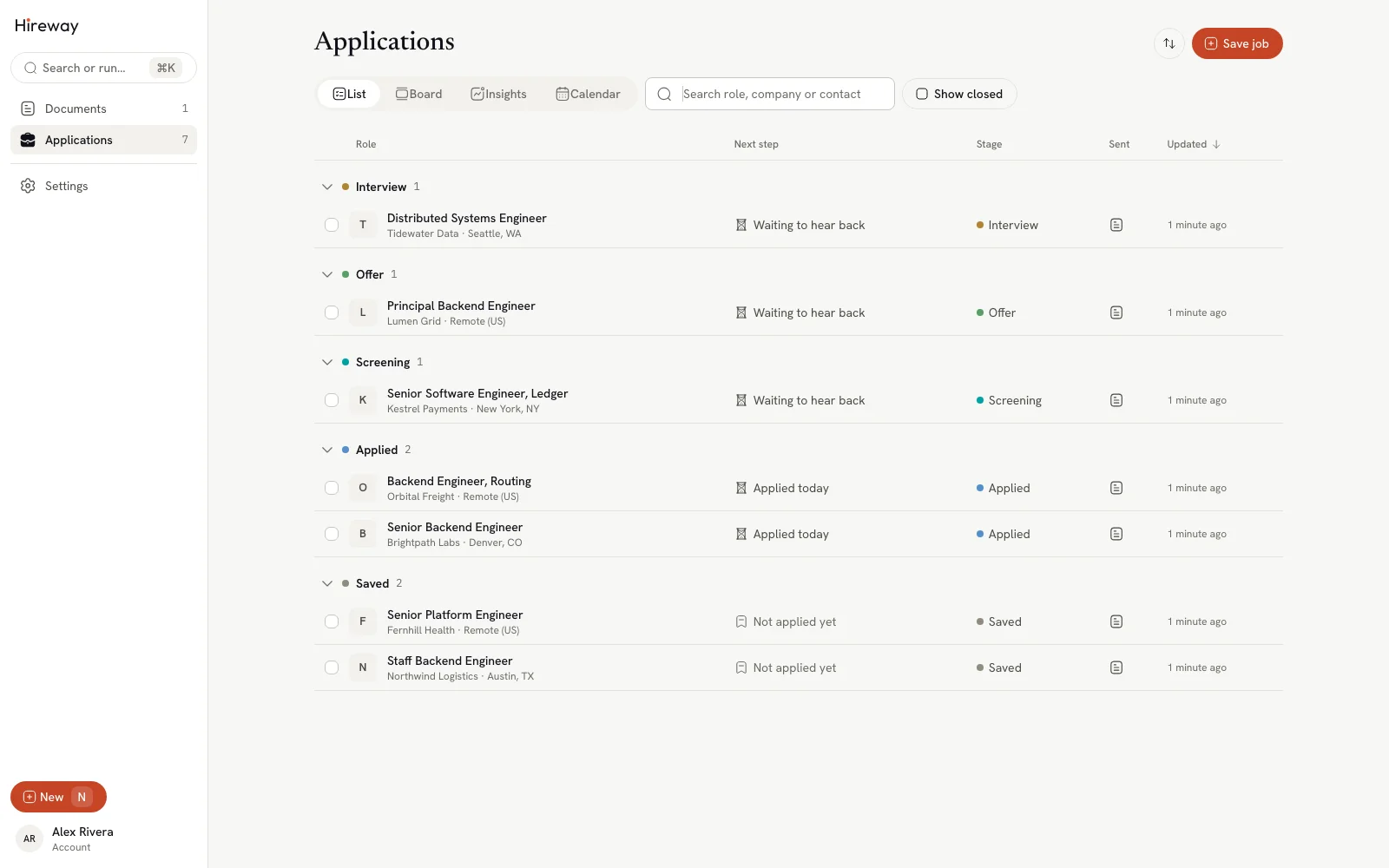
The default view. Applications are grouped by stage in the order that usually needs you first: Interview, Offer, Screening, Applied, Saved, then Closed when shown.
- Select a group heading to collapse or expand it.
- Select the Role, Next step or Updated column heading to sort within each group. Select it again to reverse the order.
- The Next step column shows the next interview, the follow-up you set, or how long you've been waiting. It turns amber when something is overdue or you've had no reply for 10 days or more.
- The Sent column shows an icon for a linked resume and a linked letter. It says None in amber when an application was sent without a linked document.
- Select a row to open its details.
On phones, the page shows List and Insights only, and list rows show the company and next step on a second line.
Finding applications
Type in Search role, company or contact to filter the list as you type. Search looks at the role, company, location, contact names and tags. If nothing matches, select Clear search.
Show closed adds closed applications to the List, Board and Calendar views. Insights always counts every application.
Acting on several applications at once
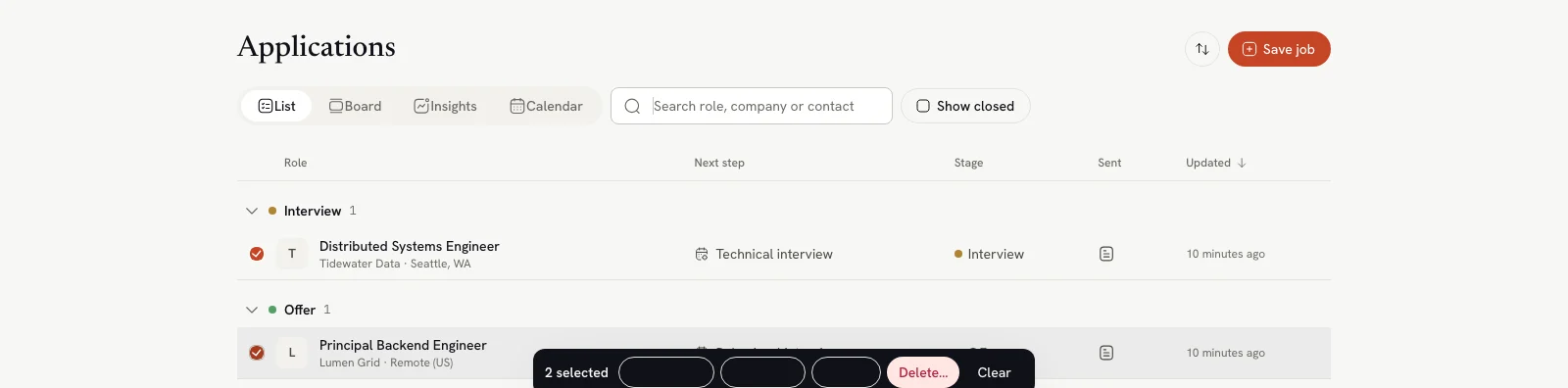
In the List view on a computer or tablet, select the checkboxes next to the applications you want. A bar appears at the bottom of the page with:
- Move to… to move them all to one stage
- Add tag to add the same tag to each
- Close… to close them all with one reason
- Delete… to delete them permanently (you're asked to confirm)
- Clear to deselect
Follow-up reminders
When an application has been at Applied for 10 days or more without a reply, a reminder appears above the list for the one that has waited longest, for example "Harborlight Labs: no reply for 17 days." Select Open to go to that application, or × to dismiss the reminder. Dismissing is remembered in this browser, so that application's reminder doesn't come back here.
Opening Applications from anywhere
Press ⌘ K (Ctrl K on Windows and Linux) and choose Applications to go to the page or to search your applications by company or role. Run New Application to open the add dialog. See Using the command bar.
Related guides
Adding an application
Paste a job link or posting and start tracking it.
Managing an application
Stages, next steps, what you sent, notes, contacts and history.
Tailoring a resume for a job
Make a copy of your resume for one application, or write a letter.
Importing applications from CSV
Bring in a spreadsheet, or export your applications.
You can also manage applications from an AI client over MCP. See Managing applications with MCP.